A brief history of the bread everyone looked for and finding out whether is still the best way of using overripe bananas.
I see these two bananas in the fruit bowl that are starting to turn the corner and apart from freezing and using into smoothies, I say to myself I should bake a banana bread. I don’t know why, but I must be one of those individuals who have never baked a banana bread before, I don’t think I have ever tasted one, and frankly I didn’t know what to look for when mixing the ingredients. I am familiar with the Italian plumcake (read ploom-cake) and because is baked in a loaf pan, the same we would use for said cake, I assumed it would look and feel the same as a cake batter.
My brain then questions “why is it called banana bread?” And here starts the rabbit hole.
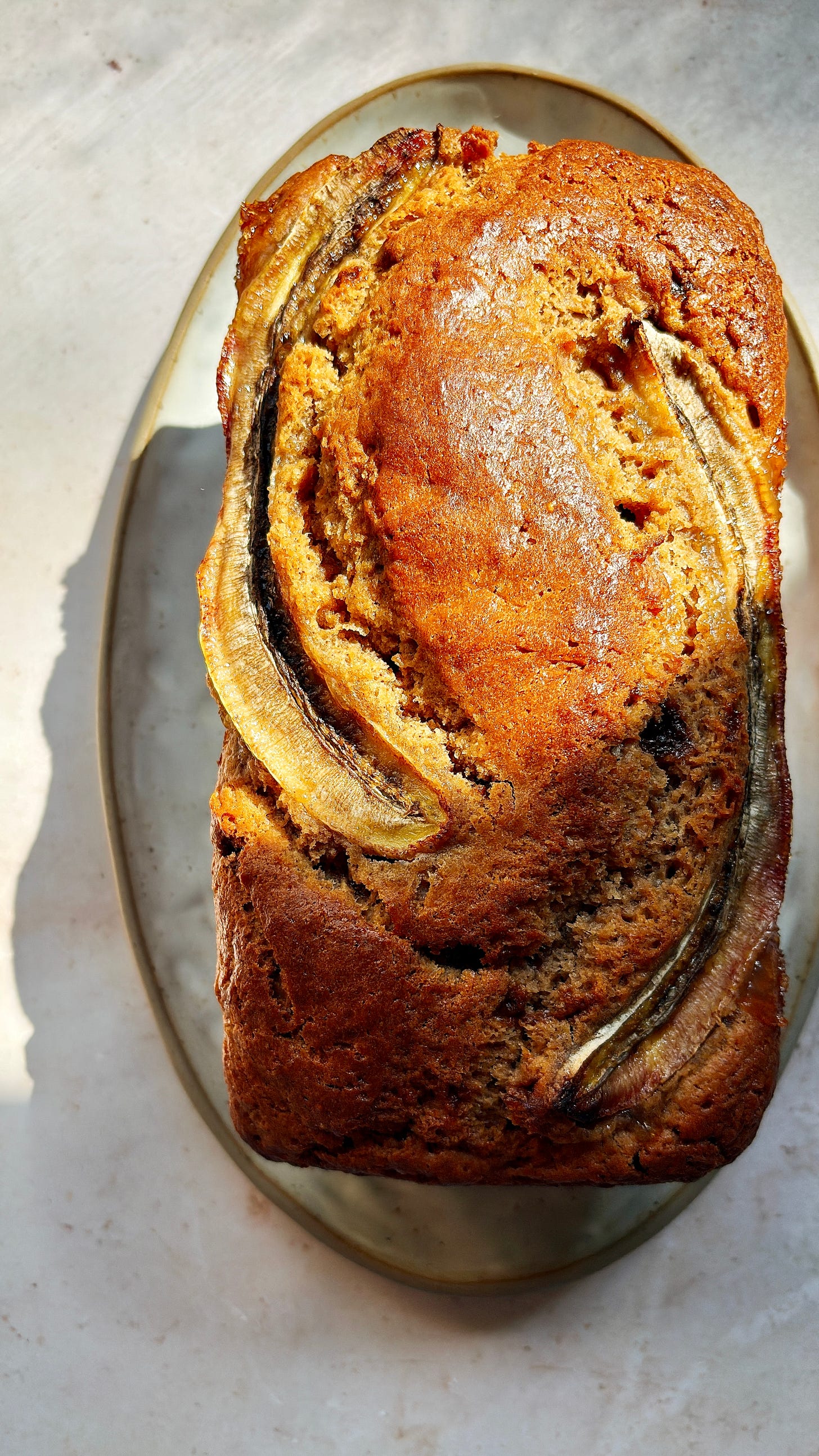
The loaf just out of the oven
smelling incredibly great
The exotic fruit gone bad
Before searching the world wide web, I look at some of my older cookery books but no mention of banana bread. I start scouring the internet reading through various articles I could find as well as an university paper, and in summary, I can say that banana bread is another great way of using what we nowadays would call as leftovers, but in the past would be a necessity, overripe bananas would be symbol of sheer thrift. A great way against food waste, but still it didn’t explain why it would be called bread. It’s only when I dig a little further that I find an explanation for it.
In the 1800s the early cargo ships couldn’t transport the delicate fruit fast enough until would rot in the hold. That changed in the early 20th century. With the advent of commercial refrigeration and expanded shipping routes, bananas flooded Western markets. Suddenly they were cheap, abundant and everywhere. But because bananas ripen rapidly at room temperature, suddenly households were faced with another problem: what to do with it.
The Great Depression and the chemical innovation
Following the crash of the Stock Market, resourcefulness became a necessity. And wasting overripe bananas was no longer an option. Instead, home cooks discovered that once mashed, the heavily freckled, near-black bananas, become a great low-cost substitute for sugar and fats, both very expensive and in short supply.
At the same time, chemical rising agents were mass-produced and became widely available. So for the first time, home bakers didn’t need yeast, long proofing times or complex mixing and kneading. Commercial flour companies and banana importers seized this moment printing banana ‘quick bread’ recipes on flour sacks and in promotional cookbooks to sell their products, and that’s how the name stuck.
One loaf, decades of changes
America really made banana bread popular in the 1930s, but it sure changed to mirror the culture and the historical eras. In WWII the loaves were plain and functional due to wartime rationing. In the 50’s the post-war baby boom called for larger, loftier loaves designed to feed families cheaply. The 60s and 70s really revolutionised the loaf with the introduction of warm spices, brown sugar and seed crust. And in the modern day there are a plethora of recipes out there, from low-sugar to classic variations with chocolate chip or nuts. It still remains one of the most sought after and researched recipe on the web.
The science behind the bake
If you read me for a while, you also know that I appreciate some science, and finding out the University Paper, it gave me a better understanding on how brown bananas work in the food chemistry world. As a banana ripens, it releases ethylene gas which breaks down complex starches into simple fructose, as oppose to a green banana which is starchy and chalky, the spotty banana functions as a natural sweetness, a natural rise and natural occurring Maillard reaction. As a result, the converted sugars mean you need far less refined sugars in the batter, the natural acidic profile reacts directly with the baking powder to create carbon dioxide bubbles and the high fructose content accelerates the caramelisation in the oven giving the loaf a rich colour and aroma.
Neil Buttery highlight: a nod to the ‘Tea Loaf’
I was researching another bread recipe for an article and the lovely Alessandra, A Curious Appetite kindly passed on historian Neil Buttery Knead to Know book. While American food history treats banana bread as a quick bread born of necessity, Neil highlights its place alongside traditional British tea loaves, such as malt loaf, dark fruit breads and brack. Instead of being eaten warm for breakfast, the loaf integrated into UK’s afternoon tea culture. Dense, aromatic and long-lasting, a slice of banana bread is served thinly sliced spread generously with salted butter and served along with a strong cup of tea.
A classic revisited
As you may all be aware, there are hundreds of recipes out there. I took inspiration from Benjamina Ebuehi recipe of peanut butter banana bread from her book The New Way to Cake and made it my own, by adapting it to what I had available in the cupboard and the two medium bananas from the intro.
The Recipe: Peanut butter banana bread, with whipped tahini and maple glaze
Ingredients for 1 loaf tin – prep time 10 min – baking time overall 40-50 min
- 2 medium overripe bananas – 1 for the topping
- 60 g smooth dark roasted peanut butter, the natural one
- 120 ml avocado oil – or any vegetable oil you may have
- 180 ml milk
- 1 tsp vanilla paste
- 300 g Regenerative AP flour
- 100 g dark muscovado sugar
- 75 g golden caster sugar
- 10 g baking powder
- 1 pinch salt
- Cinnamon to taste – we love cinnamon and used a heaped tsp
- For the whipped tahini and maple glaze
- 60 g tahini
- 100 g maple syrup
- roasted and salted peanuts to serve – Optional
Method
- Combine the dry ingredients into a bowl and ensure that these are fully blended together.
- In a second bowl mash one of the bananas and add the avocado oil, milk, peanut butter, vanilla paste and combine.
- Add the wet mix to the dry one and combine only lightly until you don’t see any more flour. You don’t want to create any gluten structure.
- Place into a lined loaf tin, I used a 2-pound one, place the sliced banana on the top and bake in a preheated oven at 180C/Gas Mark 4, for 40 minutes or until when using a wooden skewer, this comes out dry.
- Whilst the cake is cooling, prepare the glaze. Place the tahini into a bowl and whisk while pouring the maple syrup.
- Spread over the cake, and top with chopped roasted peanut for extra crunch.
